
Horseware Ireland’s Rug Series Part One Breaking Down the Turnout Rug
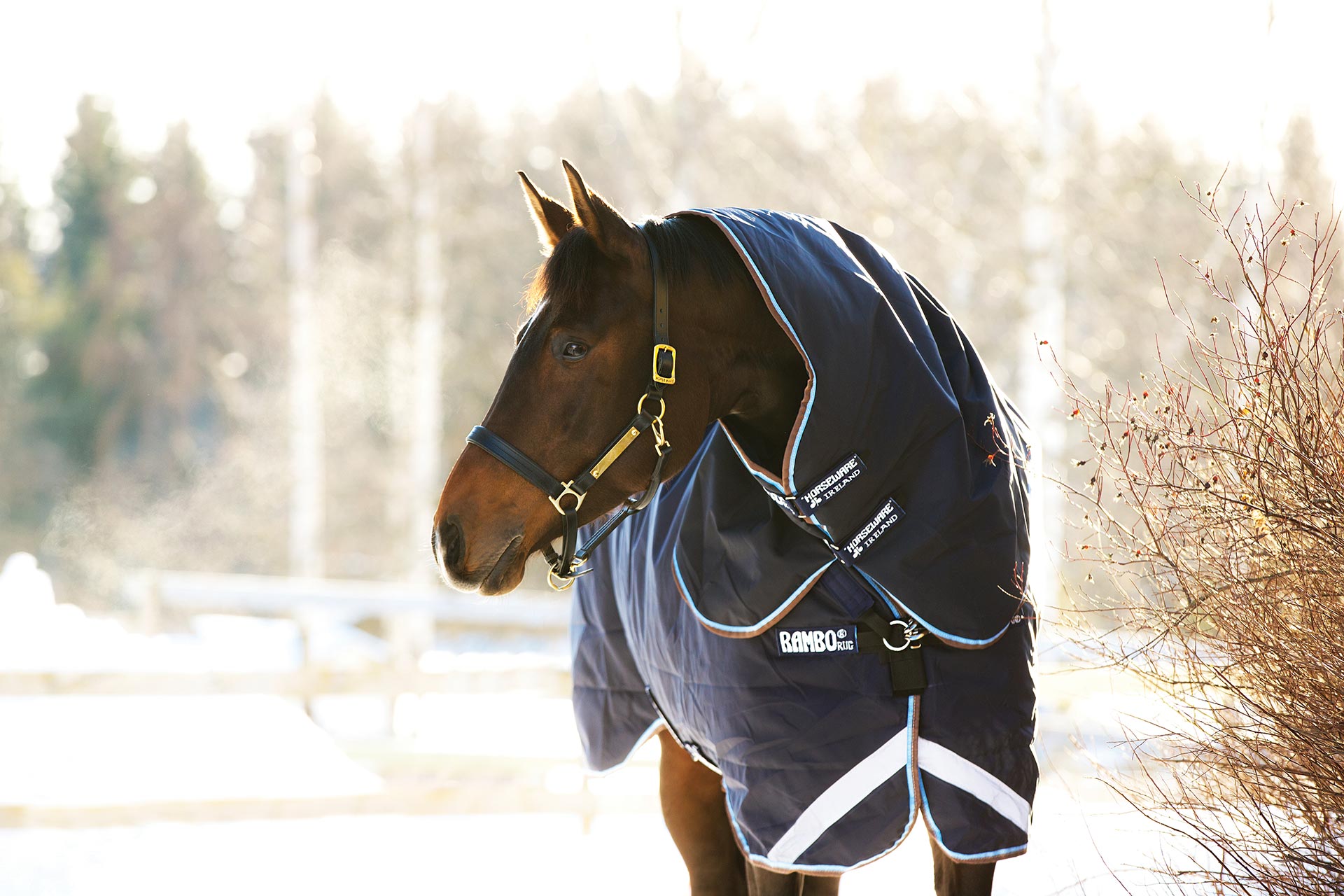
Horseware Ireland’s Rug Series Part One Breaking Down the Turnout Rug
| September 29, 2022
| 7 min read
With temperatures dropping, it’s time to transition to the cold weather essentials which can include rugs. It’s easy to spend hours online instead of in the saddle researching whether to rug or not, what style is best for your horse, and what the differences in cuts are. In this three-part blog series, Horseware Ireland will answer your questions about the rugging basics. We’ll cover the features and benefits of rugs, factors influencing rug choice, and how to rug to suit your horse’s needs.
Understanding each part of a rug is key to selecting the best one for your horse. We will break down the rug in this first part of the series so you can make an informed choice.
Types of Rug
From exercise sheets to coolers, there are lots of different types of rugs. With winter approaching, we will be focusing stable and turnout rugs.
The outer fabric is the main difference between a turnout and stable rug. This will be a waterproof layer on a turnout rug to keep your horse dry on rainy days. As a stable already offers shelter from the elements, this waterproof outer isn’t necessary on a rug designed for use in the stable.
You might see some other features on turnout rugs specifically for outdoor use such as reflective material for increased visibility and leg arches to maximise freedom of movement.
Traditionally, horses wore their turnout rug in the field and then changed to a stable rug overnight when stabled. However, since rug technology has progressed in terms of waterproofing and breathability, some owners use a turnout rug in the stable too. If you’re not one of the lucky few with a heated rug room, the warmth of your horse’s body will dry off a wet rug overnight. Your horse will stay nice and cosy in their turnout rather than this being removed while you put on a cold stable rug. Plus, you’ll save time handling damp and muddy rugs!
If the temperatures are likely to drop during the evening though consider switching to a heavier weight rug. Even if you use a turnout for both inside and outside use, remember to regularly remove the rug to check for any pressure points or rubs. After heavy or prolonged rain, it is also advisable to check your horse is still completely dry under their turnout in case you need to change to a different rug.
Rug Fabrics
Different fabrics such as polyester, polypropylene, and ballistic nylon are used for turnout rugs. These form the outer layer of the rug and differ in strength.
The type of fabric is usually accompanied by its denier, for example the Rhino Plus has a 1000D polypropylene outer.
A higher denier shows it is stronger, when comparing the same fabric, as it indicates there are more yarns within each thread. Using our example of the Rhino Plus, it has 1000 yarns within each thread.
Different fabrics can’t be directly compared by denier as each one differs in overall strength. The Rhino Plus is 1000D polypropylene so is stronger, lighter, and more durable than a rug that is 1200D polyester.
Horseware’s turnout rug collection:
- Amigo range has a polyester outer (strong)
- Rhino range has a polypropylene outer (stronger)
- Rambo range has a ballistic nylon outer (strongest)
How do I know which fabric and denier to choose?
When selecting a rug, consider your horse and their environment. If they are a known rug destroyer, or turned out with other horses prone to biting rugs, you might opt for a high denier ballistic nylon rug. The Rambo range is super tough and has a slippery outer to prevent horses gripping the fabric with their teeth.
Look for a rug with a high waterproof and breathability rating if your horse is turned out all day in adverse weather conditions or 24/7. The Rhino and Rambo turnouts use Aquatrans technology. This means their fabric can withstand 10m of water in 24 hours, and allow 3000g of vapour to pass through 1m2 of fabric in 24 hours.
There’s nothing quite like watching your horse proudly trot up to the gate in their half-torn rug. Or, having to face a miserable looking horse after the forecast said “chance of light showers”, not several hours of heavy downpour and they’re now soaked through. Taking the time to pick a rug designed to withstand your horse’s environment avoids both scenarios!
Most stable rugs will have a polyester outer but the denier can vary. If your horse still manages to damage rugs in the stable or is prone to rubbing it, you might want to select a higher denier.
Rug Linings
Both stable and turnout rugs often use a polyester lining which is breathable and smooth. Some of Horseware’s rugs also have an anti-bacterial and anti-static lining to boost shine.
Rug Weight
Rugs come in different weights which correspond to the amount of fibrefill. Your horse will be warmer in a heavier rug as it contains more fibrefill.
Light weight rugs start from no fill and go up to 100g. These are useful for hardier, unclipped horses as they keep them dry and clean. Light weight rugs can also be used in warm but wet weather.
A stable rug with no fill at all is often referred to as a stable sheet and helps to keep your horse clean.
Medium weight rugs typically have a fibrefill of 150g to 250g. These suit a range of weather conditions and horses.
Heavy weight rugs are over 300g and the warmest. These rugs are best suited to winter conditions, or for horses that feel the cold such as veterans and those fully clipped.
Some rugs in Horseware’s range use Vari-layer® technology for more heat retention with less weight. There are different layers of thermobonded fibrefill, for example a heavy weight rug with Vari-layer® has three layers that are 150g each. This allows the rug to fit snugly to the horse’s body, providing more belly coverage and trapping heat. It’s lighter for you to put the rug onto your horse and for them to wear – a win all-round!
Rug Styles
Our horses come in lots of different shapes and sizes so rugs do too.
Classic Cut
- Sits in front of the withers and frames the horse’s neck
- Classic straight front closure
- Well suited to fine boned or narrow horses, as well as youngsters
Surefit
- Sits beyond the withers to avoid pressure
- Disc Front or V-front fastening
- Suits lots of horses – very versatile
- Great for horses with broader chests or that are well-built
Wug
- High neck design to avoid pressure on the withers
- V-front fastening
- Perfect for narrower horses with high withers
All-in-one
- No seam between the neck cover and the rug
- Avoids placing pressure on the horse’s withers
- Consistent fill from ears to tail
Plus
- Includes detachable neck cover
- Velcro loop system to attach the neck cover
- Neck cover can be removed to match changing weather conditions
Fittings
The different styles of rugs use one of these fittings:
Classic Straight Front Closure – two front fastenings backed with Velcro that are easy to use. Suits horses with a narrower build.
V-Front Closure – reduces pressure on the shoulders when moving or grazing. The non-swivel trigger clips should be done up inwards and facing the horse’s chest.
Disc Front Closure – unique to Horseware, this lightweight closure is very light and safe. It prevents catching thanks to its ergonomic design that lays flat against the horse.
Finding the perfect fit for your horse is sure to be much easier now you understand each part of a rug and what to look for. The right rug goes a long way to making cold, wet days more enjoyable for you and your horse. Want to learn more about rugging? Keep an eye out for part two to discover the different factors influencing the kind of rug your horse needs.

Share on Facebook

Share on X

Share on Pinterest

Share on LinkedIn

Share on Copy